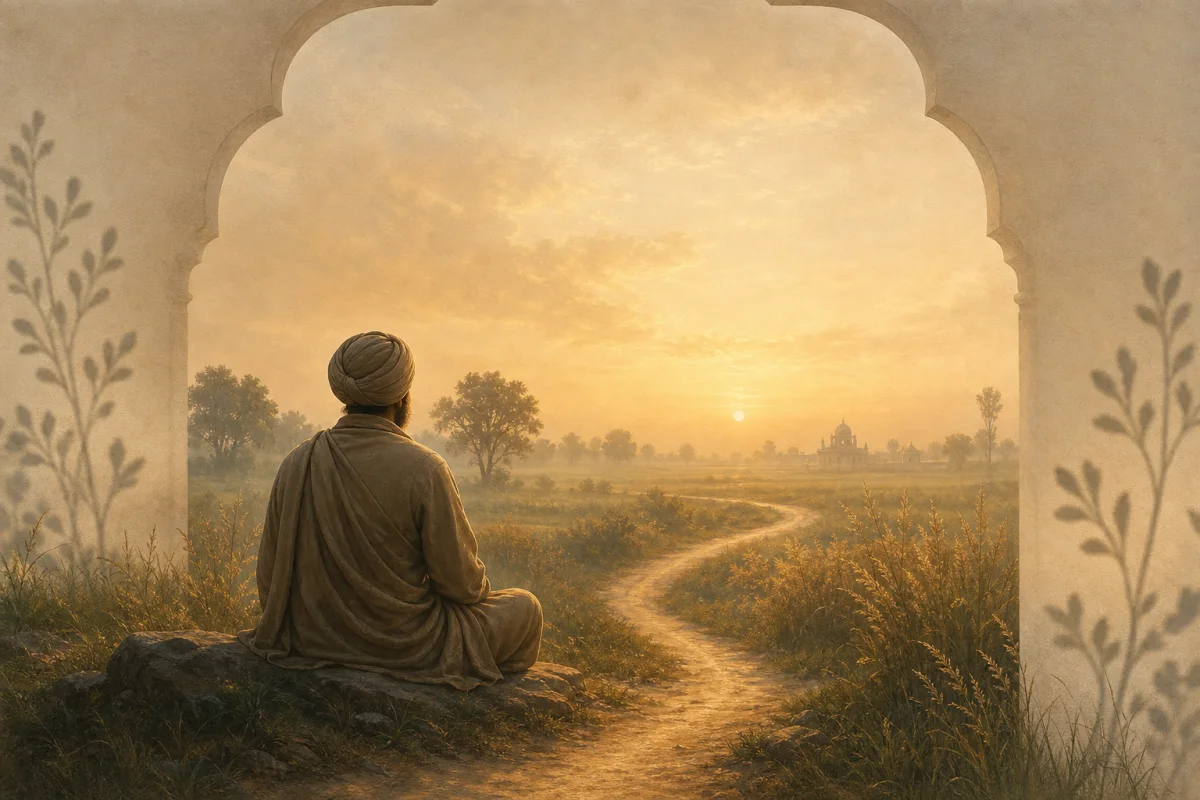

What does Saakhi mean?
In everyday Sikh conversation, Saakhi (often also written Sakhi) usually means a story, anecdote, or remembered account. You will hear the word used for episodes from the lives of the Sikh Gurus, accounts of Sikhs who lived the teachings with courage, and moments that illuminate a principle such as truthful living, seva, humility, or equality.
The English word story is useful, but it can sound fictional. Saakhis sit across several kinds of writing and memory: some preserve historical detail, some are devotional or hagiographical, and some are primarily didactic - told to make a teaching vivid. That range is why a thoughtful reader asks where an account comes from and what kind of claim it is making.
Why Sikh teachings are often carried through stories
A principle can be stated in a sentence. A story lets us watch someone choose it under pressure. Instead of only hearing “earn honestly,” we meet a worker whose simple meal carries dignity. Instead of only hearing “see every person as equal,” we see a social boundary challenged in an ordinary room.
That is what makes a Saakhi memorable: character, tension, consequence, and reflection travel together. The story gives a teaching somewhere to live.
- Stories give abstract values a human situation.
- They create questions that can be discussed in sangat or at home.
- They help a teaching return to mind when a similar choice appears in daily life.

History, devotion, and meaning are not the same thing
Treating every Saakhi as either a modern factual report or “just a myth” misses the texture of the tradition. Sikh narrative sources were written in different periods, for different communities, with different purposes. An account may be spiritually important while its historical details remain debated; another may be supported across several early sources.
When a Saakhi is shared with care, you may hear phrases such as “the traditional account tells us,” see a source named where one is known, and find uncertainty acknowledged rather than hidden. That context can bring you closer to the story without asking you to treat every kind of account in exactly the same way.
A simple way to read or listen to a Saakhi
You do not need a long study session. Give one story your full attention, then leave a little room after it. The pause is where the account stops being content and starts becoming reflection.
- Before: notice what you already know and what you may be assuming.
- During: listen for the choice, pressure, or relationship at the centre of the account.
- After: name one line or moment that stayed with you.
- Later: ask what a small, honest response could look like today.
Four questions that keep the reflection grounded
These questions work for personal reflection, a family conversation, or a small learning group. They do not force every story into one neat moral.
- What choice is being made, and what makes it difficult?
- Which Sikh value becomes visible through that choice?
- What part of the account needs more historical or cultural context?
- What is one action - not just one opinion - that could follow from it?
Sources and further reading
These links provide context for the history, terminology, or traditional account discussed above. Sehaj writes for general learning and reflection, not as a substitute for primary-source study or guidance from trusted Sikh educators.
- The Sikh Encyclopedia - Parchian Seva DasAn overview of one eighteenth-century collection of fifty Saakhis and its narrative, didactic character.
- SikhNet - About Sikh Stories for ChildrenBackground on presenting Sikh stories, spiritual lessons, and original artwork for younger listeners.